
Download EC-COUNCIL : ECSAv10 Questions & Answers as PDF & Test Software

Last Updated: Aug 31, 2026
No. of Questions: 205 Questions & Answers with Testing Engine
Download Limit: Unlimited
Reliable & Actual Study Materials for ECSAv10 Exam Success
Our Online Test Engine & Self Test Software of TestSimulate ECSAv10 actual study materials can simulate the exam scene so that you will have a good command of writing speed and time. Then multiple practices make you perfect while in the real EC-COUNCIL ECSAv10 exam. The package practice version will not only provide you high-quality ECSAv10 exam preparation materials but also various studying ways.
100% Money Back Guarantee
TestSimulate has an unprecedented 99.6% first time pass rate among our customers.  We're so confident of our products that we provide no hassle product exchange.
- Best exam practice material
- Three formats are optional
- 10 years of excellence
- 365 Days Free Updates
- Learn anywhere, anytime
- 100% Safe shopping experience
- Instant Download: Our system will send you the products you purchase in mailbox in a minute after payment. (If not received within 12 hours, please contact us. Note: don't forget to check your spam.)
EC-COUNCIL ECSAv10 Practice Q&A's

- Printable ECSAv10 PDF Format
- Prepared by ECSAv10 Experts
- Instant Access to Download
- Study Anywhere, Anytime
- 365 Days Free Updates
- Free ECSAv10 PDF Demo Available
- Download Q&A's Demo
EC-COUNCIL ECSAv10 Online Engine

- Online Tool, Convenient, easy to study.
- Instant Online Access
- Supports All Web Browsers
- Practice Online Anytime
- Test History and Performance Review
- Supports Windows / Mac / Android / iOS, etc.
- Try Online Engine Demo
EC-COUNCIL ECSAv10 Self Test Engine

- Installable Software Application
- Simulates Real Exam Environment
- Builds ECSAv10 Exam Confidence
- Supports MS Operating System
- Two Modes For Practice
- Practice Offline Anytime
- Software Screenshots
Not sure whether TestSimulate is the right fit? Download the free PDF demo of the ECSAv10 practice questions and judge the quality of our EC-COUNCIL EC-Council Certified Security Analyst (ECSA) v10 : Penetration Testing material before you spend anything.
EC-COUNCIL ECSAv10 Exam Overview:
| Certification Vendor: | EC-Council |
|---|---|
| Exam Name: | EC-Council Certified Security Analyst (ECSA) v10 : Penetration Testing |
| Exam Number: | ECSAv10 |
| Exam Format: | Multiple Choice, Proctored Exam |
| Real Exam Qty: | 150 |
| Exam Duration: | 240 minutes |
| Related Certifications: | Licensed Penetration Tester (LPT Master) Certified Ethical Hacker (CEH) EC-Council Certified Security Analyst (ECSA) |
| Exam Price: | USD 999 |
| Available Languages: | English |
| Certificate Validity Period: | 3 years |
| Passing Score: | Variable (Psychometric scoring; no fixed passing score published) |
| Sample Questions: | EC-COUNCIL ECSAv10 Sample Questions |
| Exam Way: | Online Proctored or Authorized EC-Council Test Center |
| Pre Condition: | Official ECSA training recommended. Candidates without official training must demonstrate at least 2 years of information security experience and submit an eligibility application to EC-Council. |
| Official Syllabus URL: | https://cert.eccouncil.org/ecsa-program-outline.html |
EC-COUNCIL ECSAv10 Exam Syllabus Topics:
| Section | Objectives |
|---|---|
| Topic 1: Introduction to Penetration Testing Methodologies | - Penetration Testing Processes - Assessment Planning - Penetration Testing Standards |
| Topic 2: Penetration Testing Scoping and Engagement Methodology | - Rules of Engagement - Risk Assessment - Scope Definition |
| Topic 3: Network Penetration Testing Methodology - Internal | - Lateral Movement - Internal Network Assessment - Privilege Escalation |
| Topic 4: Network Penetration Testing Methodology - Perimeter Devices | - Router and Switch Testing - Security Device Evaluation - Firewall Assessment |
| Topic 5: Network Penetration Testing Methodology - External | - Vulnerability Identification - Exploitation Techniques - External Reconnaissance |
| Topic 6: Cloud Penetration Testing Methodology | - Cloud Infrastructure Assessment - Cloud Service Security Testing - Cloud Vulnerability Analysis |
| Topic 7: Social Engineering Penetration Testing Methodology | - Awareness Evaluation - Human-Based Attacks - Phishing Assessments |
| Topic 8: Report Writing and Post Testing Actions | - Post-Engagement Activities - Penetration Test Reporting - Remediation Recommendations |
| Topic 9: Web Application Penetration Testing Methodology | - Application Reconnaissance - OWASP-Based Vulnerability Assessment - Authentication Testing |
| Topic 10: Penetration Testing Essential Concepts | - Computer Network Fundamentals - Windows and Linux Security - Network Security Controls and Devices |
| Topic 11: Open-Source Intelligence (OSINT) Methodology | - OSINT Analysis - Passive Information Gathering - Reconnaissance Techniques |
| Topic 12: Database Penetration Testing Methodology | - Data Security Testing - Database Vulnerability Assessment - Database Enumeration |
| Topic 13: Wireless Penetration Testing Methodology | - Wireless Attacks - Wireless Security Validation - Wireless Reconnaissance |
Common Questions About the EC-COUNCIL ECSAv10 Exam
The ECSAv10 exam is the official EC-COUNCIL exam behind EC-COUNCIL EC-Council Certified Security Analyst (ECSA) v10 : Penetration Testing — passing it earns you the ECSA certification, a credential positioned at the Professional level. It is built for candidates who want to validate the skills measured by EC-COUNCIL EC-Council Certified Security Analyst (ECSA) v10 : Penetration Testing. Depending on your track, the exam is also linked to the Certified Ethical Hacker (CEH), EC-Council Certified Security Analyst (ECSA) and Licensed Penetration Tester (LPT Master) certifications, so one pass can move you toward more than one EC-COUNCIL credential.
The ECSAv10 exam presents 150 questions to be completed within 240 minutes. That pace leaves little room for second-guessing: read each question carefully on the first pass, flag the ones you want to revisit, and keep moving instead of stalling on a single item. Before exam day, run at least one full timed session in the TestSimulate desktop or online test engine with a comparable question load — a steady rhythm under the clock is a trainable skill, and it is often what separates a pass from a near miss.
To pass the ECSAv10 exam you need Variable (Psychometric scoring; no fixed passing score published), and the official registration fee is USD 999. Keep in mind that a failed attempt means paying that fee again in full — retakes are not discounted. Given the cost, self-test before you book: if you can score comfortably above the passing mark on two or three consecutive timed TestSimulate practice tests, your budget is far better spent on the exam itself than on a retake.
Official ECSA training recommended. Candidates without official training must demonstrate at least 2 years of information security experience and submit an eligibility application to EC-Council. Because EC-COUNCIL revises its certification programs from time to time, treat this as a starting point rather than the final word. Confirm the current eligibility requirements on the official EC-COUNCIL exam page before you register.
Yes. A free PDF demo of the ECSAv10 practice questions is available, so you can check the question style and answer quality before spending anything. Every purchase also includes 365 days of free updates — whenever EC-COUNCIL adjusts the EC-COUNCIL EC-Council Certified Security Analyst (ECSA) v10 : Penetration Testing blueprint, your material is refreshed at no cost during that period. After the first year, you can extend the update service at a 50% discount from your member zone.
TestSimulate backs your purchase with a 100% Money Back Guarantee. If you take the corresponding exam within 60 days of purchase and do not pass, you can claim a full refund by submitting a scanned copy of your exam enrollment slip together with the official Score Report PDF within 2 days of your exam date; approved claims are processed within 7 days. The guarantee applies only to the exam matching your purchase, the candidate name must match the payer name, and it does not cover attempts taken within 3 days of purchase, candidates who downloaded the material but never sat the exam, expired orders, or free materials. If you would rather keep preparing, you can exchange the product for two free exam preparation packages of equal value and keep the update service on your original purchase.
Delivery is instant: your download is available right after payment, and a copy is emailed to you within one minute. If nothing arrives within 2 hours, check your spam folder and contact our support team. There is no limit on the number of computers you can install the software on.
The EC-COUNCIL EC-Council Certified Security Analyst (ECSA) v10 : Penetration Testing syllabus is organized into 13 domains. Among the headline areas are Cloud Penetration Testing Methodology, Penetration Testing Essential Concepts, Introduction to Penetration Testing Methodologies. Rather than copying every subtopic here, we keep the complete, current outline in the Exam Topics section above — work through it domain by domain with the TestSimulate ECSAv10 practice questions so nothing on the blueprint catches you off guard.
EC-COUNCIL EC-Council Certified Security Analyst (ECSA) v10 : Penetration Testing Sample Questions:
Question 1
Rule of Engagement (ROE) is the formal permission to conduct a pen-test. It provides top-level guidance for conducting the penetration testing. Various factors are considered while preparing the scope of ROE which clearly explain the limits associated with the security test.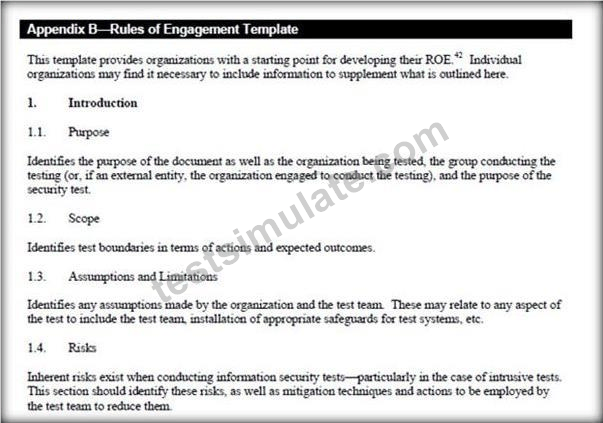
Which of the following factors is NOT considered while preparing the scope of the Rules of Engagment (ROE)?
A. Specific IP addresses/ranges to be tested
B. Points of contact for the penetration testing team
C. A list of acceptable testing techniques
D. A list of employees in the client organization
Question 2
Identify the injection attack represented in the diagram below: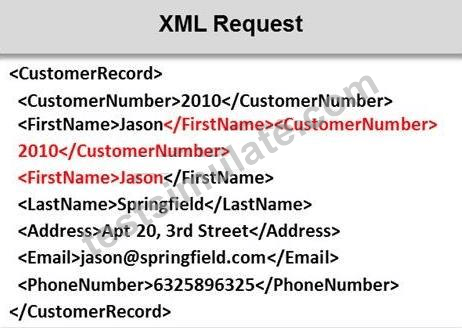
A. XML Injection Attack
B. XPath Injection Attack
C. XML Request Attack
D. Frame Injection Attack
Question 3
Logs are the record of the system and network activities. Syslog protocol is used for delivering log information across an IP network. Syslog messages can be sent via which one of the following?
A. UDP and SMTP
B. SMTP
C. TCP and SMTP
D. UDP and TCP
Question 4
Which Wireshark filter displays all the packets where the IP address of the source host is 10.0.0.7?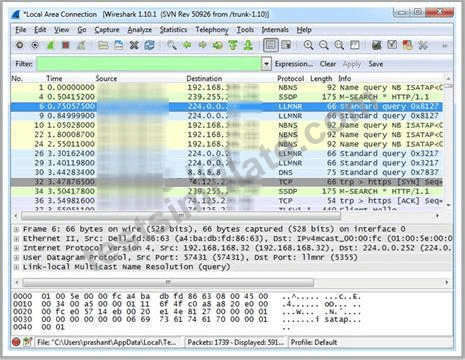
A. ip.dstport==10.0.0.7
B. ip.port==10.0.0.7
C. ip.src==10.0.0.7
D. ip.dst==10.0.0.7
Question 5
The Internet is a giant database where people store some of their most private information on the cloud, trusting that the service provider can keep it all safe. Trojans, Viruses, DoS attacks, website defacement, lost computers, accidental publishing, and more have all been sources of major leaks over the last 15 years.
What is the biggest source of data leaks in organizations today?
A. Insufficient IT security budget
B. Vulnerabilities, risks, and threats facing Web sites
C. Weak passwords and lack of identity management
D. Rogue employees and insider attacks
Solutions:
| Question 1 Answer: D | Question 2 Answer: A | Question 3 Answer: D | Question 4 Answer: C | Question 5 Answer: D |
 Tobey
Tobey
Ahern
Bart
Carl
Donald
Gerald
James
TestSimulate is the world's largest certification preparation company with 99.6% Pass Rate History from 73993+ Satisfied Customers in 148 Countries.

Over 73993+ Satisfied Customers


