
PECB Certified ISO/IEC 27005 Risk Manager (ISO-IEC-27005-Risk-Manager) Free Practice Test
Question 1
Scenario 8: Biotide is a pharmaceutical company that produces medication for treating different kinds of diseases. The company was founded in 1997, and since then it has contributed in solving some of the most challenging healthcare issues.
As a pharmaceutical company, Biotide operates in an environment associated with complex risks. As such, the company focuses on risk management strategies that ensure the effective management of risks to develop high-quality medication. With the large amount of sensitive information generated from the company, managing information security risks is certainly an important part of the overall risk management process. Biotide utilizes a publicly available methodology for conducting risk assessment related to information assets. This methodology helps Biotide to perform risk assessment by taking into account its objectives and mission. Following this method, the risk management process is organized into four activity areas, each of them involving a set of activities, as provided below.
1. Activity area 1: The organization determines the criteria against which the effects of a risk occurring can be evaluated. In addition, the impacts of risks are also defined.
2. Activity area 2: The purpose of the second activity area is to create information asset profiles. The organization identifies critical information assets, their owners, as well as the security requirements for those assets. After determining the security requirements, the organization prioritizes them. In addition, the organization identifies the systems that store, transmit, or process information.
3. Activity area 3: The organization identifies the areas of concern which initiates the risk identification process. In addition, the organization analyzes and determines the probability of the occurrence of possible threat scenarios.
4. Activity area 4: The organization identifies and evaluates the risks. In addition, the criteria specified in activity area 1 is reviewed and the consequences of the areas of concerns are evaluated. Lastly, the level of identified risks is determined.
The table below provides an example of how Biotide assesses the risks related to its information assets following this methodology:
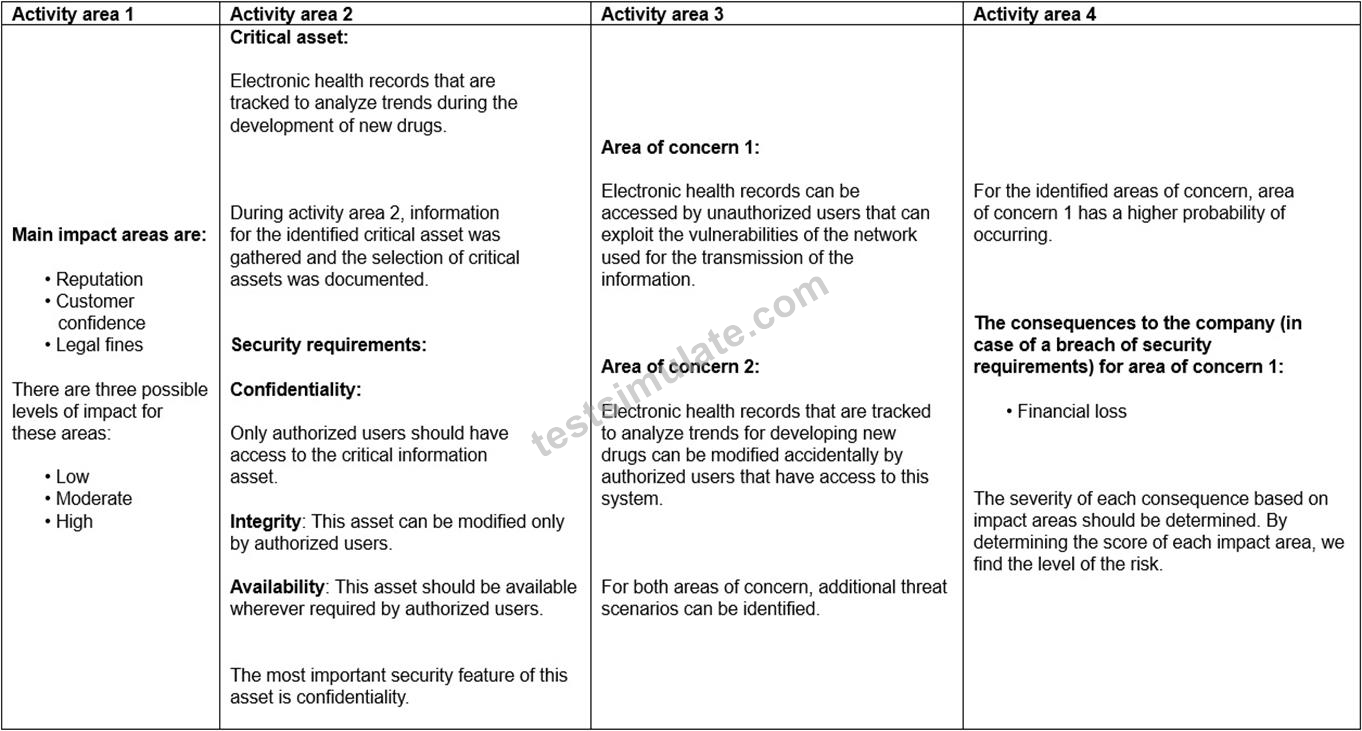
Based on scenario 8, how should Biotide use the criteria defined in the activity area 1?
As a pharmaceutical company, Biotide operates in an environment associated with complex risks. As such, the company focuses on risk management strategies that ensure the effective management of risks to develop high-quality medication. With the large amount of sensitive information generated from the company, managing information security risks is certainly an important part of the overall risk management process. Biotide utilizes a publicly available methodology for conducting risk assessment related to information assets. This methodology helps Biotide to perform risk assessment by taking into account its objectives and mission. Following this method, the risk management process is organized into four activity areas, each of them involving a set of activities, as provided below.
1. Activity area 1: The organization determines the criteria against which the effects of a risk occurring can be evaluated. In addition, the impacts of risks are also defined.
2. Activity area 2: The purpose of the second activity area is to create information asset profiles. The organization identifies critical information assets, their owners, as well as the security requirements for those assets. After determining the security requirements, the organization prioritizes them. In addition, the organization identifies the systems that store, transmit, or process information.
3. Activity area 3: The organization identifies the areas of concern which initiates the risk identification process. In addition, the organization analyzes and determines the probability of the occurrence of possible threat scenarios.
4. Activity area 4: The organization identifies and evaluates the risks. In addition, the criteria specified in activity area 1 is reviewed and the consequences of the areas of concerns are evaluated. Lastly, the level of identified risks is determined.
The table below provides an example of how Biotide assesses the risks related to its information assets following this methodology:
Based on scenario 8, how should Biotide use the criteria defined in the activity area 1?
Correct Answer: A
Explanation: Only visible for TestSimulate members. You can sign-up / login (it's free).
Question 2
Scenario 1
The risk assessment process was led by Henry, Bontton's risk manager. The first step that Henry took was identifying the company's assets. Afterward, Henry created various potential incident scenarios. One of the main concerns regarding the use of the application was the possibility of being targeted by cyber attackers, as a great number of organizations were experiencing cyberattacks during that time. After analyzing the identified risks, Henry evaluated them and concluded that new controls must be implemented if the company wants to use the application. Among others, he stated that training should be provided to personnel regarding the use of the application and that awareness sessions should be conducted regarding the importance of protecting customers' personal data.
Lastly, Henry communicated the risk assessment results to the top management. They decided that the application will be used only after treating the identified risks.
According to scenario 1, Bontton wanted to use an application that ensures only authorized users have access to customers' personal dat a. Which information security principle does Bontton want to ensure in this case?
The risk assessment process was led by Henry, Bontton's risk manager. The first step that Henry took was identifying the company's assets. Afterward, Henry created various potential incident scenarios. One of the main concerns regarding the use of the application was the possibility of being targeted by cyber attackers, as a great number of organizations were experiencing cyberattacks during that time. After analyzing the identified risks, Henry evaluated them and concluded that new controls must be implemented if the company wants to use the application. Among others, he stated that training should be provided to personnel regarding the use of the application and that awareness sessions should be conducted regarding the importance of protecting customers' personal data.
Lastly, Henry communicated the risk assessment results to the top management. They decided that the application will be used only after treating the identified risks.
According to scenario 1, Bontton wanted to use an application that ensures only authorized users have access to customers' personal dat a. Which information security principle does Bontton want to ensure in this case?
Correct Answer: B
Explanation: Only visible for TestSimulate members. You can sign-up / login (it's free).
Question 3
Scenario 4: In 2017, seeing that millions of people turned to online shopping, Ed and James Cordon founded the online marketplace for footwear called Poshoe. In the past, purchasing pre-owned designer shoes online was not a pleasant experience because of unattractive pictures and an inability to ascertain the products' authenticity. However, after Poshoe's establishment, each product was well advertised and certified as authentic before being offered to clients. This increased the customers' confidence and trust in Poshoe's products and services. Poshoe has approximately four million users and its mission is to dominate the second-hand sneaker market and become a multi-billion dollar company.
Due to the significant increase of daily online buyers, Poshoe's top management decided to adopt a big data analytics tool that could help the company effectively handle, store, and analyze dat a. Before initiating the implementation process, they decided to conduct a risk assessment. Initially, the company identified its assets, threats, and vulnerabilities associated with its information systems. In terms of assets, the company identified the information that was vital to the achievement of the organization's mission and objectives. During this phase, the company also detected a rootkit in their software, through which an attacker could remotely access Poshoe's systems and acquire sensitive data.
The company discovered that the rootkit had been installed by an attacker who had gained administrator access. As a result, the attacker was able to obtain the customers' personal data after they purchased a product from Poshoe. Luckily, the company was able to execute some scans from the target device and gain greater visibility into their software's settings in order to identify the vulnerability of the system.
The company initially used the qualitative risk analysis technique to assess the consequences and the likelihood and to determine the level of risk. The company defined the likelihood of risk as "a few times in two years with the probability of 1 to 3 times per year." Later, it was decided that they would use a quantitative risk analysis methodology since it would provide additional information on this major risk. Lastly, the top management decided to treat the risk immediately as it could expose the company to other issues. In addition, it was communicated to their employees that they should update, secure, and back up Poshoe's software in order to protect customers' personal information and prevent unauthorized access from attackers.
Based on scenario 4, which scanning tool did Poshoe use to detect the vulnerability in their software?
Due to the significant increase of daily online buyers, Poshoe's top management decided to adopt a big data analytics tool that could help the company effectively handle, store, and analyze dat a. Before initiating the implementation process, they decided to conduct a risk assessment. Initially, the company identified its assets, threats, and vulnerabilities associated with its information systems. In terms of assets, the company identified the information that was vital to the achievement of the organization's mission and objectives. During this phase, the company also detected a rootkit in their software, through which an attacker could remotely access Poshoe's systems and acquire sensitive data.
The company discovered that the rootkit had been installed by an attacker who had gained administrator access. As a result, the attacker was able to obtain the customers' personal data after they purchased a product from Poshoe. Luckily, the company was able to execute some scans from the target device and gain greater visibility into their software's settings in order to identify the vulnerability of the system.
The company initially used the qualitative risk analysis technique to assess the consequences and the likelihood and to determine the level of risk. The company defined the likelihood of risk as "a few times in two years with the probability of 1 to 3 times per year." Later, it was decided that they would use a quantitative risk analysis methodology since it would provide additional information on this major risk. Lastly, the top management decided to treat the risk immediately as it could expose the company to other issues. In addition, it was communicated to their employees that they should update, secure, and back up Poshoe's software in order to protect customers' personal information and prevent unauthorized access from attackers.
Based on scenario 4, which scanning tool did Poshoe use to detect the vulnerability in their software?
Correct Answer: A
Explanation: Only visible for TestSimulate members. You can sign-up / login (it's free).
Question 4
An organization decided to use nonnumerical categories, i.e., low, medium, and high for describing consequence and probability. Which risk analysis methodology is the organization using?
Correct Answer: A
Explanation: Only visible for TestSimulate members. You can sign-up / login (it's free).
Question 5
Scenario 3: Printary is an American company that offers digital printing services. Creating cost-effective and creative products, the company has been part of the printing industry for more than 30 years. Three years ago, the company started to operate online, providing greater flexibility for its clients. Through the website, clients could find information about all services offered by Printary and order personalized products. However, operating online increased the risk of cyber threats, consequently, impacting the business functions of the company. Thus, along with the decision of creating an online business, the company focused on managing information security risks. Their risk management program was established based on ISO/IEC 27005 guidelines and industry best practices.
Last year, the company considered the integration of an online payment system on its website in order to provide more flexibility and transparency to customers. Printary analyzed various available solutions and selected Pay0, a payment processing solution that allows any company to easily collect payments on their website. Before making the decision, Printary conducted a risk assessment to identify and analyze information security risks associated with the software. The risk assessment process involved three phases: identification, analysis, and evaluation. During risk identification, the company inspected assets, threats, and vulnerabilities. In addition, to identify the information security risks, Printary used a list of the identified events that could negatively affect the achievement of information security objectives. The risk identification phase highlighted two main threats associated with the online payment system: error in use and data corruption After conducting a gap analysis, the company concluded that the existing security controls were sufficient to mitigate the threat of data corruption. However, the user interface of the payment solution was complicated, which could increase the risk associated with user errors, and, as a result, impact data integrity and confidentiality.
Subsequently, the risk identification results were analyzed. The company conducted risk analysis in order to understand the nature of the identified risks. They decided to use a quantitative risk analysis methodology because it would provide more detailed information. The selected risk analysis methodology was consistent with the risk evaluation criteri a. Firstly, they used a list of potential incident scenarios to assess their potential impact. In addition, the likelihood of incident scenarios was defined and assessed. Finally, the level of risk was defined as low.
In the end, the level of risk was compared to the risk evaluation and acceptance criteria and was prioritized accordingly.
Based on scenario 3, Printary used a list of identified events that could negatively influence the achievement of its information security objectives to identify information security risks. Is this in compliance with the guidelines of ISO/IEC 27005?
Last year, the company considered the integration of an online payment system on its website in order to provide more flexibility and transparency to customers. Printary analyzed various available solutions and selected Pay0, a payment processing solution that allows any company to easily collect payments on their website. Before making the decision, Printary conducted a risk assessment to identify and analyze information security risks associated with the software. The risk assessment process involved three phases: identification, analysis, and evaluation. During risk identification, the company inspected assets, threats, and vulnerabilities. In addition, to identify the information security risks, Printary used a list of the identified events that could negatively affect the achievement of information security objectives. The risk identification phase highlighted two main threats associated with the online payment system: error in use and data corruption After conducting a gap analysis, the company concluded that the existing security controls were sufficient to mitigate the threat of data corruption. However, the user interface of the payment solution was complicated, which could increase the risk associated with user errors, and, as a result, impact data integrity and confidentiality.
Subsequently, the risk identification results were analyzed. The company conducted risk analysis in order to understand the nature of the identified risks. They decided to use a quantitative risk analysis methodology because it would provide more detailed information. The selected risk analysis methodology was consistent with the risk evaluation criteri a. Firstly, they used a list of potential incident scenarios to assess their potential impact. In addition, the likelihood of incident scenarios was defined and assessed. Finally, the level of risk was defined as low.
In the end, the level of risk was compared to the risk evaluation and acceptance criteria and was prioritized accordingly.
Based on scenario 3, Printary used a list of identified events that could negatively influence the achievement of its information security objectives to identify information security risks. Is this in compliance with the guidelines of ISO/IEC 27005?
Correct Answer: C
Explanation: Only visible for TestSimulate members. You can sign-up / login (it's free).
Question 6
Scenario 3: Printary is an American company that offers digital printing services. Creating cost-effective and creative products, the company has been part of the printing industry for more than 30 years. Three years ago, the company started to operate online, providing greater flexibility for its clients. Through the website, clients could find information about all services offered by Printary and order personalized products. However, operating online increased the risk of cyber threats, consequently, impacting the business functions of the company. Thus, along with the decision of creating an online business, the company focused on managing information security risks. Their risk management program was established based on ISO/IEC 27005 guidelines and industry best practices.
Last year, the company considered the integration of an online payment system on its website in order to provide more flexibility and transparency to customers. Printary analyzed various available solutions and selected Pay0, a payment processing solution that allows any company to easily collect payments on their website. Before making the decision, Printary conducted a risk assessment to identify and analyze information security risks associated with the software. The risk assessment process involved three phases: identification, analysis, and evaluation. During risk identification, the company inspected assets, threats, and vulnerabilities. In addition, to identify the information security risks, Printary used a list of the identified events that could negatively affect the achievement of information security objectives. The risk identification phase highlighted two main threats associated with the online payment system: error in use and data corruption After conducting a gap analysis, the company concluded that the existing security controls were sufficient to mitigate the threat of data corruption. However, the user interface of the payment solution was complicated, which could increase the risk associated with user errors, and, as a result, impact data integrity and confidentiality.
Subsequently, the risk identification results were analyzed. The company conducted risk analysis in order to understand the nature of the identified risks. They decided to use a quantitative risk analysis methodology because it would provide more detailed information. The selected risk analysis methodology was consistent with the risk evaluation criteri a. Firstly, they used a list of potential incident scenarios to assess their potential impact. In addition, the likelihood of incident scenarios was defined and assessed. Finally, the level of risk was defined as low.
In the end, the level of risk was compared to the risk evaluation and acceptance criteria and was prioritized accordingly.
Which of the following situations indicates that Printary identified consequences of risk scenarios? Refer to scenario 3.
Last year, the company considered the integration of an online payment system on its website in order to provide more flexibility and transparency to customers. Printary analyzed various available solutions and selected Pay0, a payment processing solution that allows any company to easily collect payments on their website. Before making the decision, Printary conducted a risk assessment to identify and analyze information security risks associated with the software. The risk assessment process involved three phases: identification, analysis, and evaluation. During risk identification, the company inspected assets, threats, and vulnerabilities. In addition, to identify the information security risks, Printary used a list of the identified events that could negatively affect the achievement of information security objectives. The risk identification phase highlighted two main threats associated with the online payment system: error in use and data corruption After conducting a gap analysis, the company concluded that the existing security controls were sufficient to mitigate the threat of data corruption. However, the user interface of the payment solution was complicated, which could increase the risk associated with user errors, and, as a result, impact data integrity and confidentiality.
Subsequently, the risk identification results were analyzed. The company conducted risk analysis in order to understand the nature of the identified risks. They decided to use a quantitative risk analysis methodology because it would provide more detailed information. The selected risk analysis methodology was consistent with the risk evaluation criteri a. Firstly, they used a list of potential incident scenarios to assess their potential impact. In addition, the likelihood of incident scenarios was defined and assessed. Finally, the level of risk was defined as low.
In the end, the level of risk was compared to the risk evaluation and acceptance criteria and was prioritized accordingly.
Which of the following situations indicates that Printary identified consequences of risk scenarios? Refer to scenario 3.
Correct Answer: C
Explanation: Only visible for TestSimulate members. You can sign-up / login (it's free).
Question 7
Can organizations obtain certification against ISO 31000?
Correct Answer: C
Explanation: Only visible for TestSimulate members. You can sign-up / login (it's free).